The short answer
If your Facebook page is bringing you all the work you want, and you are happy for that to carry on being true, you do not urgently need anything else. Plenty of businesses run for years on a page and word of mouth.
But that sentence has three conditions in it, and most businesses fail at least one. The page is not bringing in enough. Or it is, but the owner has no idea what would happen if it stopped. Or the work is coming in from people who found the business somewhere else entirely and only checked the page afterwards.
The real question is not whether a Facebook page can do the job. It is what you are relying on, who controls it, and what happens on the day that changes. Those are three different questions and a page answers none of them well.
The one line version
A Facebook page is somewhere you can be found. A website is somewhere you own. Those are not the same thing, and the difference only becomes obvious when you need it.
What a Facebook page is genuinely good at
This is not an argument that social media is a waste of time. A page does several things a website will never do as well, and any advice that pretends otherwise is selling you something.
It is where conversations already happen
People message a page the way they would text a friend. There is no form to fill in, no wondering whether anyone reads the inbox. For a lot of trades and local services, the majority of first contact now arrives as a message rather than a call, and a page is built for exactly that.
It is quick and it costs nothing to start
You can have a page up in twenty minutes. No domain, no hosting, no design decisions. For a business testing whether an idea has legs, that speed genuinely matters.
It is good at showing that you are still trading
A photograph of yesterday's job, posted yesterday, tells someone you are active in a way that a website's static gallery does not. Recency is the thing a page communicates best, and it is worth a lot when somebody is deciding whether to trust you.
Local recommendations run through it
When somebody asks a local group for a recommendation, the replies are page links. That is a real source of work, it happens without you doing anything, and it only works if you have a page for people to tag.
So keep the page. None of what follows is an argument for deleting it. The argument is about what else you need, and why.
The thing most people miss: you are renting the ground
Your Facebook page feels like yours. You made it, you post to it, your name is on it. But read what you actually agreed to. Under Meta's terms of service and its community standards, Meta can remove content, restrict a page or disable an account, and it does not need your agreement to do it.
That is not a scandal. It is the deal on every platform, and it is the price of a free service that reaches billions of people. But it means your page is not an asset you own. It is a permission you have been granted, and permissions get withdrawn.
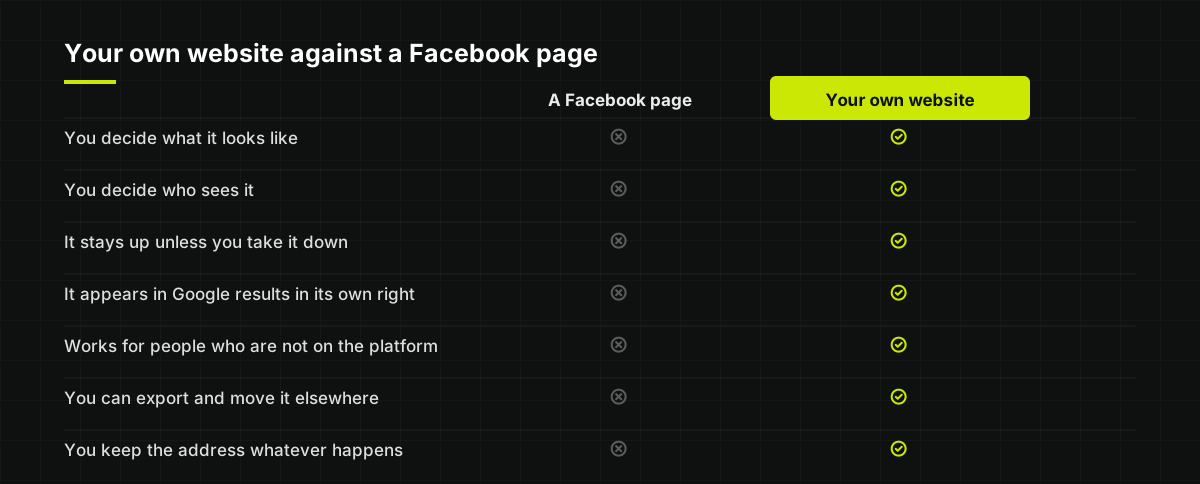
The practical test is simple. Ask yourself what you would still have tomorrow if your page vanished tonight. If the answer is a phone that stops ringing and no way to reach the people who used to find you, that is worth knowing now rather than then.
A website is different in one specific way that matters more than any design consideration: the domain is registered in your name, the files are yours, and if you fall out with whoever built it or hosts it, you take it elsewhere. We put that in writing in our terms for exactly this reason, because plenty of people in this industry do not.
What your follower count is actually worth
Here is the number that surprises people. When you post to your page, only a small fraction of the people who follow it will see the post.
In 2012 a page post reached roughly 16% of its followers. It has fallen a long way since. Analysis collected by Hootsuite and others puts current organic reach somewhere between 1% and 6%, depending on the page and on who is counting. Those studies do not measure quite the same thing and you should treat any single headline number with suspicion. What none of them show is a recovery.
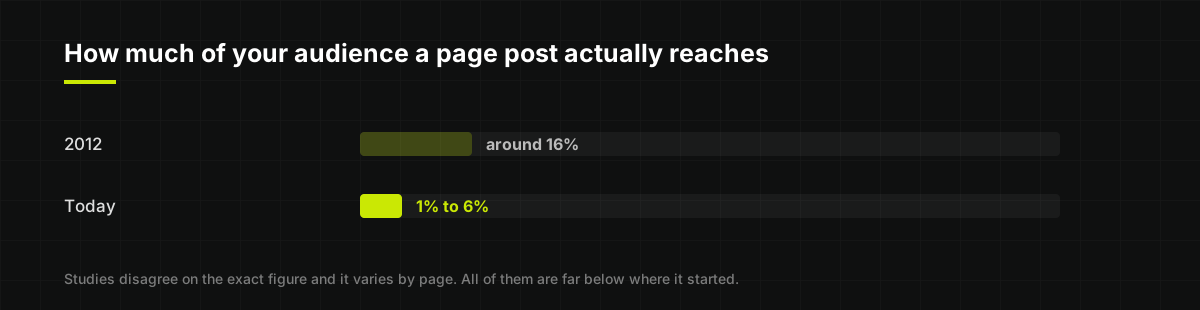
Take the middle of that range. A page with 2,000 followers, posting something genuinely useful, might reach 60 people. Of those, a handful read it. Of those, one might act. That is not a marketing channel, it is a raffle.
There is a reason for this and it is not a conspiracy. Facebook sells advertising. Pages compete for space with adverts that pay. The platform has no commercial reason to give unpaid business posts a generous share of the feed, and it has said as much. To reach your own followers reliably, you pay.
Worth sitting with
You did the work to gather those followers. You do not get to reach them without paying, and the price is set by somebody else, and it goes up.
Compare that with a website page that ranks in Google for what you do. It does not need boosting. It does not decay because you stopped posting for a fortnight. Somebody searches, they land, they call. We wrote about how that actually works in our guide to getting found on Google.
What happens on the day it goes wrong
Most business owners never think about this until it happens to somebody they know. The failure modes are ordinary and they are more common than you would guess.
- The page gets restricted. An automated system decides a post broke a rule. Appeals go into a queue. There is no phone number.
- The account is compromised. Somebody gets into the personal profile that administers the page. Recovering a page after that can take weeks, and sometimes does not work.
- The admin leaves. The page was set up under an employee's personal profile, or a relative's, and that person is no longer around or no longer speaking to you.
- The rules change. What was allowed last year is not allowed this year, and enforcement is retroactive.
In every one of those cases, the business that also had a website carried on trading. The one that did not lost its shopfront, its enquiry inbox and its entire back catalogue of reviews and photographs in an afternoon.
It is worth being precise about what gets lost, because people underestimate it. Not just the posts. The reviews you spent three years earning. The photographs of jobs you no longer have the originals of, because the phone they were taken on is two phones ago. The message history that told you who asked about what. The link that is printed on your van.
And the recovery route is not a person. It is a form, then a wait, then in many cases an automated decision that repeats the first one. Meta publishes its community standards and an appeals process, and both are genuine, but neither is a phone number and neither runs to your timescale.
This is the real argument for a website, and it has nothing to do with design. It is that a business should not have a single point of failure it does not control.
The customers who will never see your page
It is easy to forget, when you use Facebook every day, that a large share of people either do not use it or do not use it for this. They are not going to search inside a social network to find a plumber. They are going to type what they want into Google.
And here is the part that catches people out: a Facebook page does appear in Google results, but weakly, and you have almost no control over how. You cannot set the page title Google shows. You cannot write the description. You cannot add the structured data that produces the extra detail some results carry. You are one of many pages on somebody else's domain, competing against every other page on that domain.
A website of your own can be built to answer the exact question somebody typed. Google's own search documentation is public and explains what it looks for. On your own site you can act on all of it. On a page you can act on almost none of it.
There is a middle option worth taking whether or not you build a site: a Google Business Profile. It is free, it puts you on the map, and for local trades it often produces more enquiries than either a page or a website on its own. It is not a substitute for either, and it is the single highest return hour of work available to a local business.
How people actually decide whether to trust you
Watch somebody choose a tradesperson or a salon. They do not read carefully. They scan for reasons to rule you out.
A page gives them a few of those reasons for free. If the last post was eight months ago, the business looks closed. If the cover photo is stretched, it looks careless. If the reviews are good but the About section is empty, they cannot tell whether you cover their area. None of that is fair, and all of it happens in about four seconds.
A website gives you the chance to answer the questions in the order they are asked: what you do, where you do it, what it looks like when it is finished, what it costs, how to reach you. That is the whole job, and we went through it properly in what to put on a small business website.
There is also a quieter signal. A business with its own domain and its own email address at that domain reads as more established than one with a page and a free email account. It is not logic, it is pattern matching, and your customers do it whether they mean to or not.
Whose audience is it?
This is the part that takes longest to sink in, and it is the one that costs the most.
When somebody follows your page, you have not gained a contact. You have gained a permission slip that Facebook holds on your behalf and can revoke. You cannot export the list. You cannot email those people. You cannot ring them. You cannot take them with you if you decide the platform is no longer worth your time. You know a number, and the number is not yours.
Compare that with the least glamorous thing a website does: collect an email address. Somebody who gives you their address on your own site is a contact you hold. You can reach them next week without asking permission from anybody or paying for the privilege. If every platform vanished tomorrow, that list would still work.
For a lot of small businesses this matters more than the website itself. A joiner with 400 email addresses of past customers has something genuinely valuable. A joiner with 4,000 page followers has a number that looks better and does less.
A useful way to think about it
Followers are people you are allowed to shout at, sometimes, if the algorithm agrees.
Contacts are people you can actually reach. Only one of those survives a change of platform.
You do not need a newsletter or a marketing plan to benefit from this. A single form on a site you own, collecting addresses from people who wanted to hear from you, quietly builds something no platform can take away.
The enquiries you never knew you missed
Every business we speak to that runs on messages alone has the same blind spot: they know about the enquiries they answered. They have no idea about the ones they did not.
Messages arrive in an inbox that also contains everything else. They arrive on a phone that is in a pocket, on a ladder, under a sink. They get read on a lock screen, half answered in your head, and then buried. They arrive from people whose message requests were filtered into a folder you have never opened. None of that shows up as a lost job, because you never knew there was a job to lose.
A form on your own site behaves differently in one boring but decisive way: it lands in email, with a subject line, in a place you already check for money. It waits. It does not scroll. If you want, it also lands in a spreadsheet, so you can see how many came in last month rather than guessing.
None of that is exciting. It is the difference between a channel you manage and a channel that manages you.
Job by job: which one does what
Rather than argue in the abstract, here is the same list of jobs a small business needs done, with an honest answer for each.
| The job | Facebook page | Your own website |
|---|---|---|
| Being found by someone searching Google | Weak and indirect | This is what it is for |
| Showing you are active this week | Excellent | Needs updating to match |
| Answering questions before someone calls | Buried in posts | A page per question |
| Taking bookings or enquiries reliably | Messages, easily missed | Forms that reach your inbox |
| Explaining a service in detail | Poor, posts scroll away | Good, it stays put |
| Being recommended in a local group | Excellent | Needs the link shared |
| Surviving a platform ban | It does not | Unaffected |
| Proving you are a real business | Partly | Yes, with a domain of your own |
| Costing nothing to start | Yes | Depends who builds it |
Read down the two columns and the answer stops being an argument. They are not competitors. They are good at almost exactly opposite things, and the businesses doing best are running both.
But a page is free and a website is not
This is usually the real objection, and it deserves a straight answer rather than a sales one.
A page costs nothing to set up. A website, built properly by somebody who knows what they are doing, has historically cost anywhere from several hundred pounds to several thousand, and that gap is the reason a lot of small businesses never got one. We went through the whole picture, route by route, in how much a website actually costs.
Two things are worth knowing before you decide the price settles it.
The first is that a page is not free either, it is just that you pay in a different currency. You pay in reach you have to buy back, in time spent feeding an algorithm, and in the risk you are carrying by having no fallback. Those costs do not appear on an invoice, which is exactly why they get ignored.
The second is that the build and the running of a site are two different bills, and people conflate them. The design and build is the large one time cost that stops most businesses. Keeping a site online afterwards is a much smaller ongoing one, and it is the same sort of routine expense as a phone line.
Our answer to the first of those is to remove it. We design and build the site at no charge: no build fee and no design fee. What it costs to keep a site running afterwards is set out plainly in our terms, in full, before you agree to anything, because the thing we like least about this industry is a price you only find out at the end.
When a Facebook page really is enough
We build websites, so treat this section with appropriate suspicion. It is still true.
A page on its own is a reasonable answer if all of these apply:
- You are testing an idea and do not yet know whether it will work.
- Every customer you want comes from a community you are already inside, and that community lives on Facebook.
- You have no service that needs explaining, no prices that need setting out and no area that needs defining.
- You would be genuinely fine if the page disappeared, because the work comes from people who know you.
If that is you, spend the time on the page instead. Keep it current, fill in every field, answer messages quickly, and come back to this when one of those four stops being true.
What we would push back on is the version of this that is really just avoidance: the business turning over real money, relying on a page it does not control, telling itself it is fine because nothing has gone wrong yet.
The setup that works: both, doing different jobs
The businesses that get this right stop treating it as a choice. They give each one the job it is good at.
- The website is the answer. Everything that needs to be findable, readable and permanent lives there: services, areas covered, prices or price ranges, examples of finished work, how to get in touch.
- The page is the noise. Yesterday's job, the van outside a landmark, the before and after, the seasonal reminder. Things that are worth seeing once and do not need to be found again.
- Every post points home. The page bio carries the website address. Posts that describe a service link to the page about that service. The traffic you already have starts landing somewhere you own.
- The Google Business Profile ties them together. It links to the site, carries the reviews, and puts you on the map for people who never open Facebook at all.
That arrangement also solves the reach problem sideways. You are no longer trying to reach 2,000 followers through an algorithm. You are collecting the ones who act, on ground you control, in a form that keeps working after the post has scrolled away.
You do not have to choose between them
We design and build the website, free, so you can keep doing what already works on Facebook and stop depending on it. No build fee and no design fee.
Where to start this week
If you have read this far and decided you want something of your own, here is the order that wastes the least time.
- Register a domain in your own name. Not through whoever builds the site, and not in somebody else's account. This is the one thing that must be yours from day one.
- Claim your Google Business Profile. Free, an hour of work, and often the fastest source of enquiries a local business has.
- Write down the five questions you get asked most. That list is the site. It is genuinely most of the work, and only you can do it.
- Gather what you already have. Photographs of finished work, the wording you use when you describe the job, any certifications or registrations. Most of it is already on your phone.
- Then build it, or have it built. By that point the hard part is done.
If you would rather not do the last step yourself, that is what we are for. We design and build the site around your business at no charge, you see what we make during a free trial before you pay anything, and the domain stays yours. Have a look at the kinds of business we build for, or start with what a website actually is if any of the words above were new.