The short answer
For a straightforward small business website, a handful of pages, built by somebody competent, the figures quoted across UK pricing guides for 2026 cluster between about £800 and £6,000. Most fall between £1,500 and £4,500.
Below that you are usually looking at a template filled in quickly, or at your own time rather than someone else's. Above it you are usually paying for something genuinely bigger: a shop, a booking system, an integration with software you already run.
That is a wide band, and the width is not the industry being cagey. It is that the word website covers a five page site for a plumber and a platform that takes ten thousand orders a week. Nobody would ask what a vehicle costs and expect one number.
The honest version
The price depends almost entirely on how much thinking somebody has to do, and how much of the work you are able to do yourself. Everything below is really about those two things.
Why the range is so wide
Four things move the number more than anything else.
How much has to be decided from scratch
A site built on a template with your logo dropped in is a few hours. A site designed around your business, where somebody works out what your customers need to see and in what order, is days. The pixels are not the expensive part. The deciding is.
Who is doing it
A freelancer working from a spare room has almost no overheads. An agency has an office, a project manager, a designer, a developer and a margin on top. Both can produce good work. You are not only paying for the site, you are paying for the structure that produced it.
Whether the content exists
This is the one that surprises people. If you arrive with your text written, your photographs taken and your services listed, a build is quick. If somebody has to interview you, write the words and arrange photography, that is a different job with a different price. It is also the single biggest cause of a quote coming in higher than expected.
What it has to do
A site that describes a service is one thing. A site that takes payments, manages stock, books appointments against a live calendar or talks to your accounting software is another. Each of those is a system, not a page.
The five things you are actually paying for
Quotes are usually presented as one number, which makes them impossible to compare. Underneath, almost every website build is these five things in some proportion.
- Thinking. Working out who the site is for, what they need, what you want them to do and how the whole thing should be arranged. Invisible in the finished product and the part that decides whether it works.
- Design. How it looks and how it feels to use. Typography, spacing, colour, the order things appear in on a phone.
- Building. Turning that into something that actually loads, on every screen size, quickly, without breaking.
- Content. The words and the pictures. Sometimes yours, sometimes theirs, and if it is theirs it costs money.
- Setting it live and looking after it. Domain, hosting, certificates, then the updates and fixes that follow forever.
When two quotes are £1,200 apart, the difference is almost always in the first item and the fourth. Ask which, and a lot of the mystery goes away.
The five routes, and what each really costs
Here is each option with its real price and its real trade off. We build websites for a living, so weigh the last row accordingly; the first four are described as honestly as we can.
Doing it yourself in a website builder
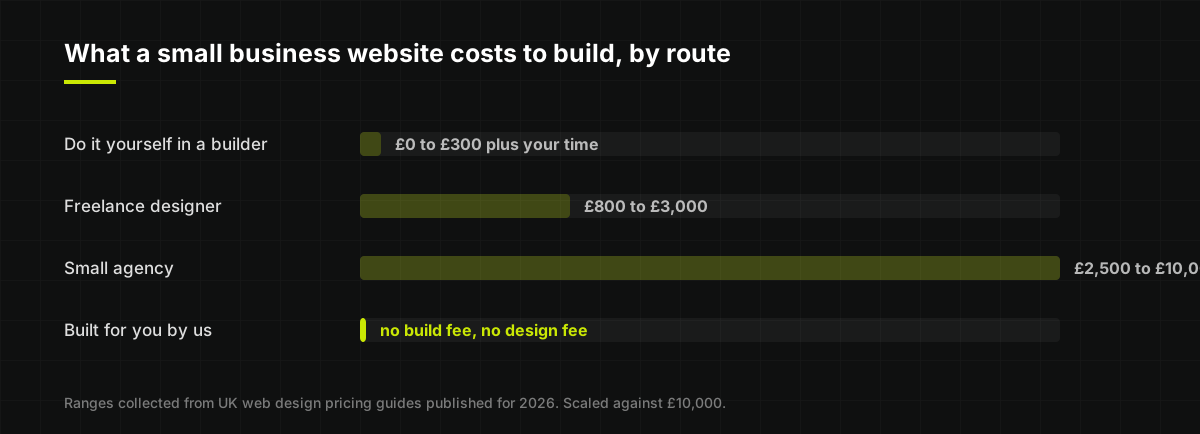
£0 to about £300 a year, plus your time. The builders are genuinely good now and for a very simple site this can work.
The cost people forget is the weekend, then the next weekend. Most business owners we speak to who tried this either finished something they were not proud of, or did not finish. If your time is worth anything at all, the maths is worse than it looks. We wrote about that trade off in more detail on our free website builder page.
A freelance designer
Around £800 to £3,000 for a straightforward small business site, with most simple four or five page builds landing near the middle.
Often the best value in the market. The risks are the ordinary ones of dealing with one person: they get busy, they take a full time job, they stop answering. Ask what happens in a year when you need a change.
A web design agency
Around £2,500 to £10,000 for a standard small business site, and higher in London for the same specification.
You are buying reliability and a team rather than an individual. For a business where the site is central, that is worth paying for. For a five page site describing a local service, you are frequently paying for process you do not need.
An offshore marketplace
£100 to £600. Genuinely cheap, and occasionally fine.
The recurring problems are communication, ownership and abandonment. Sites arrive built on licences held by the developer, in page builders nobody local can maintain, with no handover. When it goes wrong there is nobody in your time zone to ring. If you go this route, settle the ownership questions in writing first.
Built for you at no charge
No build fee and no design fee. That is what we do, and it is worth explaining why it is not a trick.
We do not charge for the design and the build. We make our money keeping the site running afterwards, and we would rather have a business that stays with us for years than a one off fee. It only works if the site is good enough that you want to keep it, which is a useful incentive to have pointed at us rather than away from you. The full commercial arrangement, in plain English and with no surprises, is on our terms page before you agree to anything.
The costs nobody puts in the quote
These are small individually and they add up, and they are the usual reason a build costs more than the number you were given.
| What | Typical cost | Who usually pays |
|---|---|---|
| Domain name | Roughly £8 to £20 a year for a .co.uk or .com | You, annually, forever |
| SSL certificate | Free via Let's Encrypt, or £50 or more a year if sold to you | Should be included |
| Hosting | A few pounds a month upward | Ongoing |
| Photography | £200 to £600 for a half day | You, if you want good pictures |
| Copywriting | £100 to £500 for a small site | You, unless quoted in |
| Stock images | £10 to £50 each, or free from a library | Varies |
| Changes after launch | £40 to £100 an hour, or included | Ask before you sign |
| Email at your domain | A few pounds per mailbox a month | You |
Two of those deserve a note. An SSL certificate from Let's Encrypt is free and always has been, so anybody charging you fifty pounds a year for one should be asked why. And a domain is registered through a registrar under rules set by ICANN, with Nominet running .uk; it costs a few pounds and it should be in your name, not your designer's.
What cheap actually costs you
There is nothing wrong with spending little. There is something wrong with spending little and getting something that quietly works against you, which is a different problem and a more expensive one.
The failures we see most, in order of how often they turn up:
- It is slow. Uncompressed images and a bloated template. People leave before it loads, and Google notices. You can check any site free at PageSpeed Insights.
- It was never really built for a phone. Most visitors are on one. A site that works on a laptop and is awkward on a phone is a site that fails for the majority.
- Nothing was set up to be found. No titles worth the name, no descriptions, no structure. Google's own starter guide covers the basics, and cheap builds routinely skip all of it.
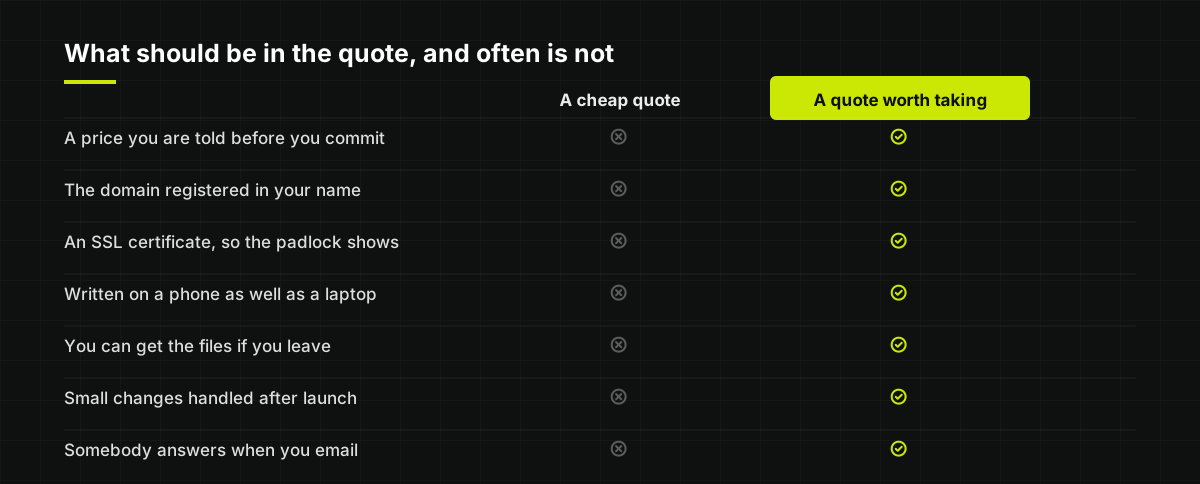
- You cannot change anything. No access, no handover, and the person who built it has moved on.
- The domain is not yours. The worst one. Registered in the builder's account, and getting it back becomes a negotiation.
The second bill is always bigger than the first. Rebuilding a bad site costs more than building a good one, because somebody has to unpick it before they start.
What it costs to keep a website running
Build cost and running cost are two different bills and conflating them is where most confusion about this subject comes from.
Once a site exists, somebody has to keep it online, keep the certificate valid, keep whatever it is built on updated, take backups and fix things when they break. That is real work and it does not stop. Every website has this cost, whether it appears as a line on an invoice, as a hosting bill you pay yourself, or as your own Sunday afternoon.
What is reasonable depends on what is included. Bare hosting with nothing else is a few pounds a month. Hosting plus updates, backups, security and somebody actually answering when you email is a managed service and costs more, because it is more. The question worth asking is not which is cheaper, it is which one leaves you with a working site in eighteen months.
What we charge to keep a site running, what it covers and how to stop are set out in full on our terms page. There is no minimum term, and every new client starts with a 10 day free trial with nothing taken during it.
Or skip the build cost entirely
We design and build the site around your business at no charge. No build fee, no design fee, and a 10 day free trial so you can see what we make before you pay anything.
What it costs by type of business
The generic range is only so useful, because what a site has to do varies enormously by trade. Here is roughly where different businesses land and, more usefully, what actually drives their number up.
Trades and local services
Usually the cheapest, because the job is clear: what you do, where you do it, proof you are real, a way to call you. Five pages covers it, and the cost driver is photography rather than complexity. If you have decent pictures of finished work on your phone, you are most of the way there. We set out what these sites need on our pages for plumbers, electricians and builders.
Restaurants and cafes
Simple in structure, awkward in one specific way: the menu changes. A site where updating a menu means emailing someone and waiting is a site that goes stale within a season. The cost driver is how that is handled, and it is worth asking about before you sign anything rather than after. More on that on our restaurants page.
Salons, barbers and studios
The cost driver here is booking. Most already use a booking platform, and the sensible answer is usually to link to it rather than rebuild it, which keeps the price down. Where costs climb is when somebody proposes building a booking system from scratch that duplicates one you already pay for. See salons and wellness studios.
Shops selling online
A different category entirely, and the honest answer is that this is where the numbers get serious. Products, stock, payments, delivery rules, returns and tax all have to work, and each is a system. Expect several thousand at minimum, and be wary of anyone quoting a few hundred.
The pattern across all of these is the same: the price follows the number of decisions and the number of moving parts, not the number of pages.
How long it takes, and why that is part of the price
Time and cost are the same conversation, because almost everything that makes a build take longer also makes it cost more.
A small site with content ready is a week or two of actual work. In practice most builds take four to eight weeks from first conversation to going live, and the difference is almost never the building.
It is waiting. Waiting for the text. Waiting for photographs. Waiting for a decision on which of two versions you prefer, which takes eleven days because you are busy running a business, which is entirely reasonable and is still eleven days.
This matters for cost in two ways. If you are paying by the hour, delay is expensive. And if you are paying a fixed price, long gaps make the job less attractive to whoever took it, which affects how quickly they come back to you.
The single best thing you can do to make a website cheaper has nothing to do with negotiating. It is to turn up with your content ready. Write down what you do, in your own words, before anybody asks. Take twenty photographs of finished work. List your services. That work has to happen regardless, and doing it up front is the difference between a four week build and a four month one. Our guide on what to put on a small business website is essentially that checklist.
Questions to ask before you pay anybody
Whoever you use, including us, these are the questions that separate a fair deal from an expensive lesson. Ask them in writing.
- Who will the domain be registered to? The answer should be you. If it is anything else, stop.
- If I leave, can I take the site? Ask specifically whether you get the files.
- What is not included? The most useful question you can ask, and the one that gets the most revealing answers.
- Who writes the words? If the answer is you, that is fine, but it is now your job and it is the job that delays launches.
- What happens when I need a change? Included, hourly, or not at all. All three are legitimate. Not knowing is not.
- What does it cost next year? Get the ongoing number before you commit, not after.
- Can I see something you built a year ago? Not a portfolio piece. A real one, still running.
Where free fits in, and what to check
Free website offers are not all the same and the differences matter. Some are genuinely free builds funded by an ongoing service. Some are trials that begin charging on a date you were told once and never reminded of. Some are free until you want to leave, at which point the site goes off and the domain turns out not to be yours.
The three things to check are always the same, and they are the same three we would want you to check on us:
- If there is a trial, are you reminded before it ends? Ours lasts 10 days, nothing is taken during it, and we email you three days before it ends so the first payment is never a surprise.
- Whose name is the domain in? It should be yours from the first day.
- What happens if you leave? You should get the files and keep the domain.
If an offer will not answer those three plainly on a public page, that is the answer.
What a website is actually worth
Cost is only half a question. The other half is what it returns, and for most small businesses the arithmetic is not close.
Take a trade where an average job is worth £400. A site that brings in one extra job a month pays for a £2,000 build inside six months and then keeps going. It works at three in the morning, it answers the same question a hundred times without getting bored, and it does not need reminding to follow up.
It is also the thing that catches people who already heard about you. Somebody is given your name in a pub, then looks you up. What they find at that moment decides whether you get the call. That happens whether or not you have a site; the only variable is what is waiting for them. We went through that in our piece on Facebook pages, and it applies just as much to word of mouth.
The number worth working out
Before you compare quotes, work out one figure: what a single new customer is worth to you over a year. Not one job, a year. A salon client who visits every six weeks is worth several hundred pounds. A boiler service customer who then calls you for a bathroom is worth thousands.
Now put that next to the quote. Most small businesses find the site pays for itself somewhere between one and five customers, which reframes the whole question. The argument stops being whether £2,000 is a lot of money, because it is, and becomes whether the site will bring in three customers in a year. That is a question you can actually answer.
It also tells you when to say no. If you sell one thing, once, for £30, and you are being quoted £6,000, the sums do not work no matter how good the site is. Very few people in this industry will tell you that, which is a reason to ask the question yourself.
Where the money is usually wasted
In our experience it is rarely spent on the wrong route. It is spent on the wrong things within the right route: a redesign of something that was working, a feature nobody uses, a rebuild prompted by boredom rather than by a problem.
A plain site that says the right things, loads quickly and is easy to contact will out-earn a beautiful one that does not, every time. If a quote is high, ask which part of it will change what a customer does. Anything that cannot be answered in that form is decoration, and decoration is optional.
None of which makes an expensive site automatically worth it. A £9,000 site that says the same thing as a £900 one is not eleven times better. What you are buying above a certain point is judgement, reliability and time you get back, and those are worth different amounts to different businesses.
If you know what you want to say, spend little. If you do not, that is the bit worth paying for, and it is the bit most quotes hide inside a single number. If you would rather it cost nothing to find out, have a look at the businesses we build for or start with what a website actually is.