
The short answer
An estate agent's website has a narrower job than most agents give it credit for, and a more important one. It is not there to compete with the portals for buyers. It is there to win the next instruction: to convince somebody thinking of selling or letting that you are the agency who will get it done.
That changes almost everything about how it should be built. The people who matter most on your site are not browsing properties. They are comparing agents, usually two or three of them, and they are looking for a reason to pick up the phone to one.
So a good agency site does four things well. It makes booking a valuation effortless. It proves you know the area and sell in it. It shows the information the rules say has to be there, plainly. And it does all of that quickly, on a phone, without getting in its own way.
The one line version
The portals are where people look at houses. Your website is where people decide which agent to trust with theirs.
The portals have the buyers. Your site has the sellers.
Buyers and tenants mostly search on the portals: Rightmove, Zoopla and OnTheMarket. That is fine, and it is not a problem your website needs to solve. Trying to rebuild a portal on your own site, with a big search box as the first thing on the homepage, is usually a mistake. Nobody is going to do their property search on one agency's site when every agency's stock is already on the portal.
Sellers and landlords behave differently. Once somebody has decided to sell, they stop looking at properties and start looking at agents. They type your name into Google after seeing a board, they compare your site against the agency down the road, and they read your reviews. That is the moment your website is working for you, and it is the moment most agency sites waste.
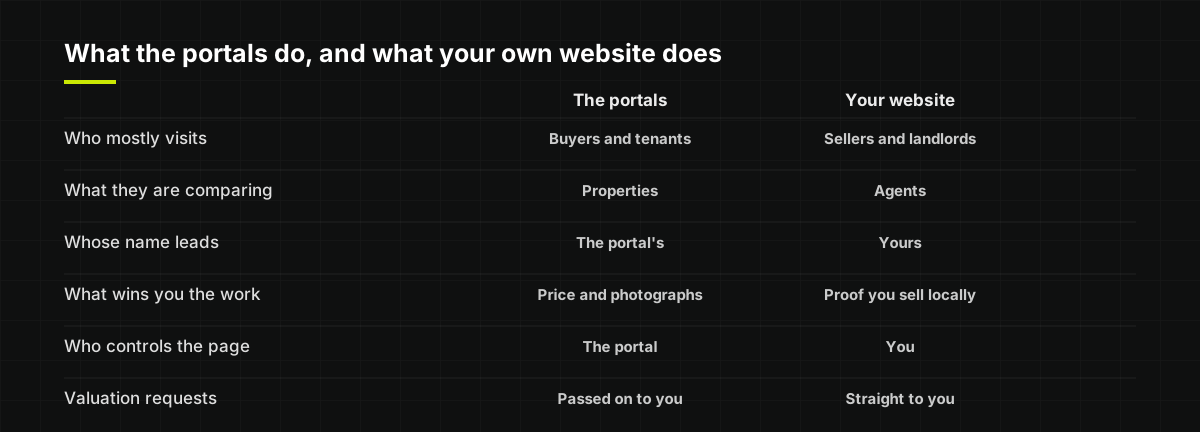
There is a second reason not to lean on the portals alone, and it is the same one we set out in our piece on Facebook pages. A portal listing is a presence on somebody else's platform, on somebody else's terms, at somebody else's price. Your website and your domain are the one part of your marketing that is actually yours.
How a seller actually chooses an agent
Talk to anybody who has sold a house recently and the process sounds familiar. They get two or three valuations. They look at who has boards up in their street. They ask a neighbour. Then they go online and check each agency before the valuations happen, and again afterwards when they are deciding.
What they are looking for is surprisingly specific:
- Do you sell houses like mine, round here? Not somewhere in the county. On these streets, at this sort of price.
- Are you any good at it? Sold properties, reviews, and a sense of how quickly homes go under offer.
- Will I actually be looked after? Who the people are, and whether they seem like people or a call centre.
- What will it cost me? Even a rough idea of how fees work, or at least an honest statement of how they are worked out.
- Are you properly regulated? Most sellers will not know the word redress, but they notice when a scheme and a membership number are missing.
Every one of those questions is answered, or not, by your website. The valuation itself happens face to face, but the shortlist that decides who gets invited round is drawn up online, often late in the evening, on a phone.
The valuation request is the whole point
If your website has one job above all others, it is producing valuation requests. Everything else on it supports that.
Put it everywhere, and keep it short
A button to book a valuation belongs in the header of every page, not buried in a menu under Sellers. On a phone it should be one tap from wherever somebody happens to be reading.
The form behind it should ask for as little as possible. Every extra field loses you requests, and the details you really need can be gathered on the phone five minutes later, by a person, which is a better start to the relationship anyway.
| Field | Ask for it? | Why |
|---|---|---|
| Name | Yes | You need to know who to ring |
| Phone number | Yes | Most valuations are booked in a conversation |
| Optional | Useful for a confirmation, not needed to book | |
| Address or postcode | Yes | It decides who goes and when |
| Selling or letting | Yes | It goes to a different person in most agencies |
| When they hope to move | Optional | Helpful, and people abandon forms that insist on it |
| The price they hope for | No | Asking before you have met puts people off |
| How they heard about you | No | Ask on the phone instead |
Instant valuation tools
Many agencies now offer an instant online valuation, which produces a rough figure from recent sold prices nearby. They do bring in contact details, and some sellers like having a number before anybody visits.
Be careful with how they are presented. An automated figure knows nothing about the extension, the new kitchen or the damp in the back bedroom, and a seller who fixes on it can be disappointed when a real valuation comes in lower. If you use one, label the result clearly as an estimate, and make the next step a proper valuation rather than a price.
Answer quickly
The best form in the world does nothing if it lands in an inbox nobody checks until Tuesday. Sellers often ask two or three agents for a valuation at the same time. The agency that rings back first is very often the one that gets through the door first.
What a fast, clean website actually means
Property websites are heavy by nature. They are full of photographs, floorplans, maps and galleries, and that is exactly why so many of them are slow. A slow site on a phone, on a station platform with patchy signal, loses people before the first photograph appears.
Fast
Google measures how a page feels to use with a set of measurements it calls Core Web Vitals. In plain terms they ask three things: how quickly the main content appears, how quickly the page responds when you tap something, and whether things jump around while it loads. Google publishes what good looks like, and the headline figure is the main content appearing within about two and a half seconds. You can test any page free, including your competitors' pages, at PageSpeed Insights.
The usual causes of a slow agency site are ordinary rather than technical: photographs uploaded straight from a camera at full size, a heavy theme doing things nobody asked for, and a stack of scripts for chat boxes, trackers and pop ups all loading before anything useful. Each one is fixable.
Clean
Clean is about what is not on the page. No pop up asking for an email address before the page has finished loading. No video that starts playing on its own. No carousel of five slides that nobody waits to see. One clear way to book a valuation, one clear way to see what you are selling, and a phone number that works when it is tapped.
Clean also reads as confident. A cluttered site looks like an agency trying hard. A calm, fast one looks like an agency that is busy selling houses, which is the impression you want a seller to leave with.
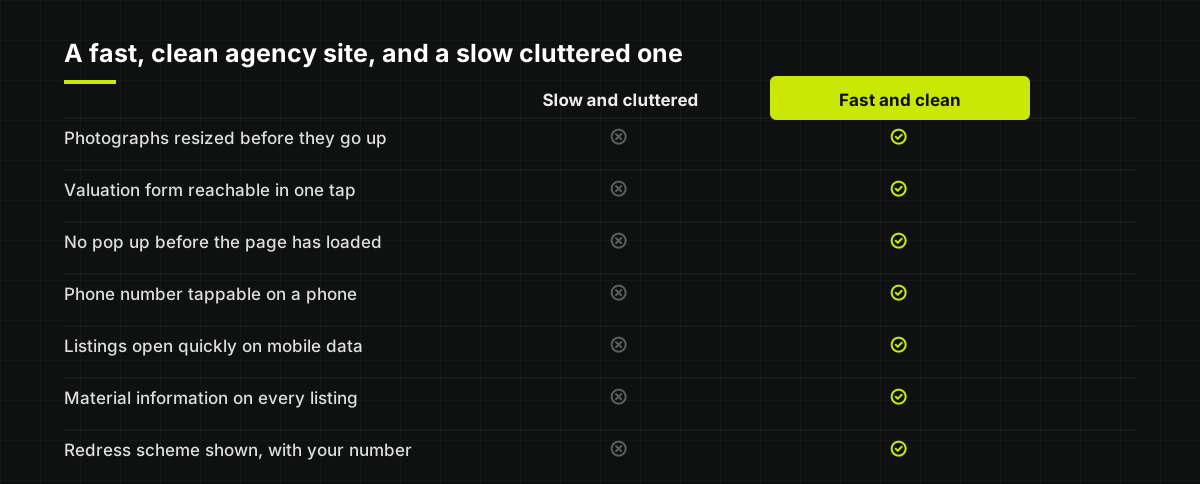
Speed also feeds into search. Google's guidance on Core Web Vitals explains how it uses page experience. It will not rescue a site with nothing useful on it, but between two agencies with similar sites, the fast one is not the one losing ground.
Listings: feed them in, never type them twice
Your properties already live in your agency software, which sends them to the portals. The mistake is keeping a second copy on the website that somebody has to update by hand. It will go out of date, and a property showing as available three weeks after it sold is exactly the sort of thing that makes a seller wonder how organised you are.
Most agency software, with systems such as Reapit, Alto and Street among them, can also supply listings to your own website, either as a feed or as a ready made search widget. Where yours does, the website should use it, so that a property added, reduced or marked sold in one place changes everywhere at once.
What that looks like depends entirely on the system you use and what your account allows. It is worth finding out before a website is designed rather than after, because it shapes how the property pages are built.
A useful question for any web designer
Ask how listings will get onto the site and who will update them. If the answer involves somebody copying them across, keep asking.
Material information on every listing
Estate and letting agents already have a legal duty, under the Consumer Protection from Unfair Trading Regulations 2008, not to leave out information a buyer or tenant needs to make a decision. National Trading Standards has published guidance, developed with the major portals, setting out what that means for property listings in practice.
The guidance comes in three parts:
- Part A covers the basics every listing needs: the price or rent, the council tax band or rate, and for sales, the tenure.
- Part B covers what should be established for every property, such as the type of property, how it is built, the number and type of rooms, utilities and parking.
- Part C covers things that only need to be established where the property is affected by a particular issue.
The portals ask for this when you list. Your own website should show the same, which is one more reason for listings to come from a single source rather than being retyped. Propertymark has published a summary of the full guidance that is worth keeping to hand.
What the rules say has to be on your website
Not legal advice
This is a plain English summary to help you plan a website, not legal advice. The rules differ between England, Wales, Scotland and Northern Ireland, and they change. Your redress scheme and your professional body are the right people to confirm exactly what applies to you.
Agents are more closely regulated than most of the small businesses we build for, and some of that regulation reaches the website directly. The main pieces:
| If you | What the website should show | Where it comes from |
|---|---|---|
| Sell or let residential property | Which redress scheme you belong to, with your membership number | The Property Ombudsman or the Property Redress Scheme |
| Let property in England or Wales | A full list of your fees, with a statement of your redress scheme | Consumer Rights Act 2015, section 83 |
| Hold client money as a letting agent | Whether you belong to a client money protection scheme, alongside those fees | Section 83, and your scheme's own rules on showing its certificate |
| Let homes to tenants in England | Only the payments tenants can still lawfully be charged | Tenant Fees Act 2019 |
| List any property to sell or let | Price or rent, council tax band, tenure and the rest of the material information | National Trading Standards guidance |
| Belong to a professional body | Your membership and number, if you choose to show it | Propertymark, for example |
The letting duties are the ones most often missed. Under section 83, a letting agent with a website has to publish its fees on it, together with a statement of which redress scheme it belongs to and, if it holds client money, whether it belongs to a client money protection scheme. Propertymark has a fact sheet on the duty that explains it in more detail.
Showing all of this clearly is not only about staying out of trouble. A seller who sees a redress scheme and a membership number, laid out properly rather than hidden in a footer, has one less thing to worry about. It is the same principle we set out for trades in what a tradesperson's website needs: a logo can be copied, a number can be checked.
Local proof is what wins the instruction
Every agent says they know the area. A website is the place you get to prove it.
Area guides that could only be about your patch
A page for each town or neighbourhood you work in, written by somebody who actually knows it: which streets sell quickly, which schools people move for, what a typical family home goes for, and what has changed in the last year. Generic text about excellent transport links and a vibrant community helps nobody and convinces nobody, because it could be about anywhere.
Pages like these also do real work in search, because people type the name of the place they live. We go into how local search works, and why a named place beats a vague region, in getting found on Google.
What you have sold, and how
Recently sold properties are the most persuasive thing an agency site can show, provided the people you sold them for are happy for you to show them. Where you can, say something about how the sale went, such as how long it took to find a buyer. Only ever publish what is accurate and what you have agreement to share.
Reviews, properly attributed
Reviews on independent platforms carry more weight than ones on your own site, because everybody knows you choose what goes on your own site. Link to your Google reviews and any independent review site you use, and show a few on the page with a first name and an area attached.
The people
Somebody is about to trust you with the sale of their home. They want to see who will turn up. Real photographs of the team, what each person does, and how long they have been doing it matter more for an agency than for almost any other kind of business.
Fees, and being clearer than the competition
Sales fees do not have to be published in the way letting fees do, and many agents keep them off the website deliberately so that the conversation happens at the valuation. That is a reasonable choice.
It is worth knowing how it looks from the other side, though. A seller comparing three agencies, only one of which says anything at all about how fees work, tends to trust that one. You do not need a price list. A plain explanation of how your fee is worked out, what it includes, and whether anything is payable if the property does not sell, goes a long way.
For lettings, the fees page is not optional, and since the Tenant Fees Act 2019 most of the fees that used to be charged to tenants in England are banned. The page should reflect what can actually still be charged, and it is worth checking it every time your fees change.
An agency website, built free
We design and build estate and letting agency websites at no charge. No build fee, no design fee, and a free trial so you see what we make before you pay anything.
Landlords are a separate audience
Plenty of agency websites treat lettings as a footnote to sales. Landlords notice. They are running a small business of their own, and they want to know quite different things from a seller:
- What levels of service you offer, from finding a tenant through to fully managing the property, and what each one involves.
- How you find and check tenants.
- How rent is collected and passed on, and how quickly.
- Who deals with repairs, and what happens at two in the morning when the boiler gives up.
- That client money is protected, and how.
A lettings section written for landlords, rather than a tab bolted onto a sales site, is one of the clearest ways a mixed agency can win managed properties, which tend to be among the steadiest income an agency has.
The pages, one by one
An agency site does not need to be enormous. It needs each question a seller or landlord has to be answered somewhere obvious.
| Page | Its one job | What most agencies get wrong |
|---|---|---|
| Home | Who you are, where you work, and how to book a valuation | Leading with a property search instead of a reason to choose you |
| Valuation | Take the request | Burying it in a menu, or asking for too much |
| Selling | Explain how you sell and how fees work | Vague promises and nothing about cost |
| Letting and landlords | Explain your services to landlords | Treating landlords as an afterthought |
| Properties | Show what you have, straight from your software | A second copy that drifts out of date |
| Area guides | Prove you know the streets | Text that could be about any town |
| About and team | Show the people who will turn up | Stock photographs and job titles |
| Fees and regulation | Show what the rules require, clearly | A PDF linked from the footer |
| Offices | Every way to reach every branch | One address for the whole agency |
Smaller independents can combine several of these on a single page. What matters is not how many pages there are, but that nobody has to hunt. There is more on putting pages in the right order in what to put on a small business website.
Photographs, of properties and of you
Property photography is a discipline of its own, and most agencies already take it seriously for their listings. The website needs a little more than that.
- Resize before upload. A photograph straight off a good camera can run to several megabytes. On a listing page with twenty of them, that is the difference between a page that opens and a page that does not.
- Floorplans and energy ratings alongside the photographs, because buyers look for both and leave when they cannot find them.
- Your office, your team, and your boards in the street. These are the photographs that sell the agency rather than the house.
- No stock photographs of smiling couples holding keys. Everybody has seen them, and they quietly undo the local credibility the rest of the site is working to build.
What goes wrong most
In rough order of how often we come across them:
- A property search as the whole homepage. It serves buyers, who are on the portals anyway, and ignores sellers, who are the reason the site exists.
- Valuations buried in a menu. The most valuable thing a visitor can do should never be three taps away.
- Listings copied across by hand. They go out of date, and it shows.
- Slow pages full of full size photographs. Worst of all on the phones most people are actually using.
- Pop ups before the page has loaded. Nothing closes a tab faster.
- Area pages that could be about anywhere. Local knowledge is the product, so generic copy undersells the one thing you have.
- Letting fees or redress details missing or hard to find. A legal problem as well as a trust one.
- A team page of logos and job titles. People want to see people.
None of these are expensive to fix, and most of them are not really design problems. They are decisions about what the site is for.
What we can do for an agency
We design and build websites around the business they are for, with no build fee and no design fee, and every new client starts with a free trial so you can see what we make before you pay anything. For an estate or letting agency, that means:
- A site built to win instructions, with the valuation request in the header of every page and a short form that lands in your inbox.
- Fast pages built for phones first, with photographs sized properly and nothing loading that does not need to.
- Listings from your agency software, where your system provides a website feed or search widget. We build around what you already use, in the same way we plug in booking systems for restaurants and salons. If your system does not offer one, we will tell you before we start rather than after.
- A page for each area you cover, laid out so your local knowledge does the work, and structured so search engines can read it.
- A clear fees and regulation page, with room for your redress scheme, membership numbers and, for lettings, your fees and client money protection. The details come from you and your scheme; our part is making sure nobody has to hunt for them.
- Separate sales and lettings sections, so landlords are spoken to as landlords.
- Your domain registered in your name, which we put in writing in our terms.
Two more things that tend to help agencies in particular. If you have outgrown an old logo, or never really had one, we can put the basics together for a small one off fee, so the website, the boards and the window cards all look like the same business. And once you are live, changes are part of the service: a new member of the team, a new area, a new office, a photograph that needs replacing. Send it over and it gets done.
Some things go beyond a website, and we will always say so before any work starts: building a property search system from scratch rather than using the one your software provides, or anything that would replace the agency software itself. If you are weighing up doing it all yourself in a website builder instead, we compare the two honestly on our free website builder page, and there is more on running costs in how much a website costs.
The checklist
Work down this on your own site, or on any site you are thinking of paying for.
- A valuation button in the header of every page, and a form of five fields or fewer.
- Listings coming from your agency software, never copied by hand.
- Price, council tax band and tenure on every listing, and the rest of the material information where it applies.
- Your redress scheme named, with your membership number.
- For lettings: your fees, your redress scheme and your client money protection position, together on the website.
- A page for each area you actually cover, written by somebody who knows it.
- Recently sold properties, shown with permission.
- Real photographs of the team.
- Independent reviews linked, not only quoted.
- A good mobile result on PageSpeed Insights.
- No pop up before the page has loaded.
- Your domain registered in your name.
A site that ticks all of those will not look like a portal, and it should not. It will look like an agency somebody would trust with their home, which is the only thing it is for. See the other kinds of business we build for, or if words like domain and hosting are still a little hazy, start with what a website actually is.