
The short answer
A trade website needs five things. Photographs of work you have actually done, proof you are registered and insured, the names of the places you cover, an obvious way to ring you, and enough about the job to tell somebody whether you are the right trade for it.
Everything else is decoration. A beautiful site with no photographs of your own work will lose to an ordinary one that has them, every time, because the person looking is not judging your website. They are using it to judge you.
The thing to hold on to
Nobody has ever chosen a tradesperson because the website looked nice. They choose because it answered the question they were nervous about, and the other one did not.
How people actually choose a trade
Watch somebody find a plumber and you notice they are not really shopping. They are eliminating.
They search, they open three or four tabs, and in each one they spend about ten seconds looking for a reason to close it. No photographs, close. Cannot tell if they cover my town, close. Last updated 2019, close. Only when a site survives that do they read anything.
So the site is not competing on quality. It is competing on not giving anybody an excuse. That is a much lower bar than most trades assume, and most trade websites still fail it.
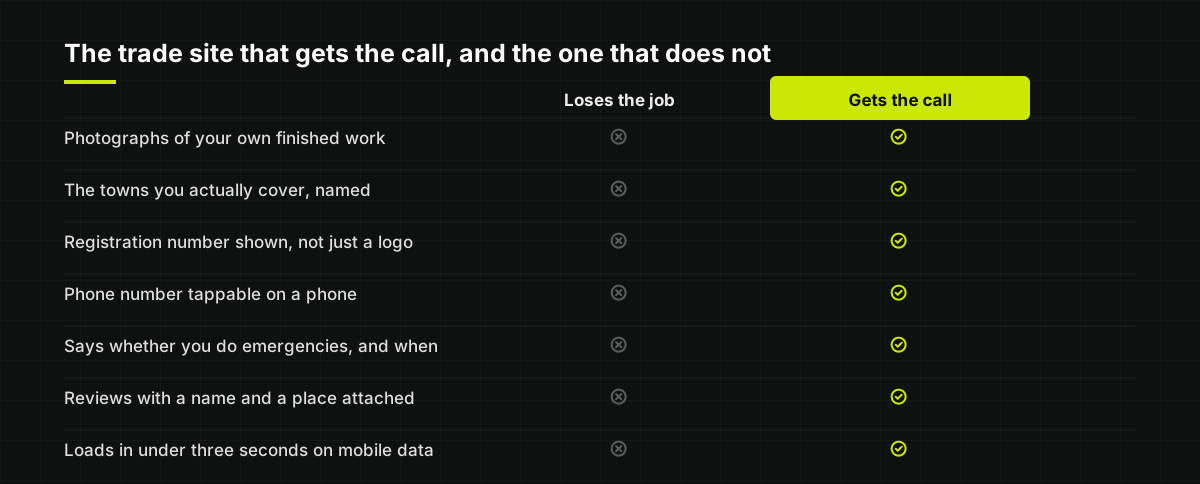
Read that list again and notice what is missing. Nothing about colours, nothing about a logo, nothing about a slider on the homepage. The things that win the call are all facts.
The photographs, and how to get them right
For most trades the photographs are the entire argument. They are the only thing on the page that proves you can do the work rather than claiming it.
Your own work, not stock
A stock photograph of a smiling man in a clean van is worse than no photograph. Everybody has seen it, it appears on a hundred other trade sites, and the moment somebody recognises it they stop believing the rest of the page.
Your worst real photograph beats the best stock one. It is yours.
Your phone is fine
You do not need a photographer. Modern phone cameras are better than the cameras used for most trade websites five years ago. What you need is the habit, not the equipment.
What to shoot, and when
| Shot | When | Why it works |
|---|---|---|
| The finished job, wide | Before you pack up | This is the one people look at |
| A close detail | Same visit | Shows the standard of the finish, which is where trades separate |
| Before, if you remember | First five minutes on site | The contrast does more selling than either shot alone |
| The work in progress | Mid job | Proves it is yours and not lifted from somewhere |
| Your van, clean, outside a real job | Any time | One of these is enough for the About page |
| You, on site, working | Get somebody to take it | The hardest one to get and the one that builds most trust |
The practical rules
- Tidy the frame first. Ten seconds moving a dust sheet and a coffee cup is the difference between looking careful and looking rushed.
- Shoot in daylight where you can. Phone cameras struggle indoors, and a dim photograph reads as a dim job.
- Hold it straight. Level lines matter more than anything else, because your work is full of straight lines and a crooked photo makes them look wrong.
- Six good ones beat forty. A gallery of forty middling photographs is worse than six that are genuinely good.
- Ask before you post a customer’s home. Almost everybody says yes. The one who does not would have minded a great deal.
If you have nothing yet, start on the next job. Six weeks of taking two photographs per job gives you a gallery that will still be working for you in five years. We go into shot lists and file sizes in what to put on a small business website.
Registrations, insurance, and what to actually show
This is the section where trades routinely undersell themselves. A logo in the footer is not proof. A number is.
The reason is simple: logos can be copied off Google Images in ten seconds, and enough dishonest traders do it that customers have learned to discount them. A registration number can be checked, which is precisely why showing one is worth something.
| If you are a | The register that matters | Show |
|---|---|---|
| Gas engineer | Gas Safe Register, which is a legal requirement for gas work | Your Gas Safe number, plainly, near the top |
| Electrician | NICEIC or NAPIT | Scheme and enrolment number, plus what it covers |
| Builder | FMB, or a competent person scheme | Membership number and what work it certifies |
| Plumber | CIPHE, and Gas Safe if you touch gas | Both, if you hold both |
| Any trade | TrustMark, which is government endorsed | The number, not just the badge |
| Any trade | Public liability insurance | The cover amount, in pounds |
Two more worth putting in writing, because customers ask and most sites make them ask:
- What your insurance actually covers, and for how much. “Fully insured” means nothing. “£2 million public liability” means something.
- Whether the work is guaranteed, and for how long. A twelve month guarantee stated plainly beats a vague promise to put things right.
If you are an electrician, the paperwork is more of the decision than it is in any other trade, which is why we gave it its own section on the electricians page. Gas work is the same: see plumbers.
The towns you cover, written out
“We cover the South West” is the single most common mistake on trade websites, and it fails twice over.
It fails for the person reading, who lives in a specific town and cannot tell whether you mean them. And it fails in search, because nobody types “plumber south west”. They type “plumber” and Google works out where they are, or they type the name of their town.
Write the towns out. All of them, by name, on a page of their own if the list is long. It reads as slightly unglamorous and it is one of the highest returning things you can do, because it answers the question that closes the most tabs.
A test worth running
Open your own site on your phone and try to find out, in ten seconds, whether you cover the next town over. If you cannot, neither can a customer.
There is a limit. Listing forty towns you would only visit for a very large job is not honest, and it produces enquiries you turn down, which wastes everybody's time. List where you actually go. There is more on how this feeds into local search in getting found on Google.
The pages, one by one
A trade site does not need many pages. It needs the right ones, each answering something specific.
| Page | The one job it does | What most trades get wrong |
|---|---|---|
| Home | Who you are, what you do, where, and how to ring you | Filling it with a slideshow instead of facts |
| Services | What you actually do, and what you do not | One vague paragraph covering everything |
| Gallery | Prove it | Stock photographs, or none |
| Areas covered | Answer “do you come here?” | A region instead of towns |
| About | Show there is a person behind it | A history of the company nobody asked for |
| Reviews | Somebody else vouching for you | Unattributed quotes that read as invented |
| Contact | Make ringing easy | A form and nothing else |
Seven pages, and several of them can be sections on the homepage for a smaller outfit. What matters is that each question gets answered somewhere obvious, not that each gets its own page.
One page worth adding if you do more than one thing: a separate page per major service. A plumber who also fits bathrooms should have a bathrooms page, because somebody searching for a bathroom fitter is a different person with a different budget from somebody with a leak.
We build these, free
We design and build trade websites at no charge. No build fee and no design fee, and a free trial so you see what we make before you pay anything.
Writing about the work, without sounding like everybody else
Open ten trade websites and nine of them open with the same sentence: quality workmanship, competitive prices, no job too small. It is invisible. Everybody says it, so nobody reads it, and it tells a customer nothing they can use.
The fix is not better adjectives. It is specifics.
| Instead of | Write |
|---|---|
| Quality workmanship guaranteed | Twelve month guarantee on all work, in writing |
| Competitive prices | £65 call out, which comes off the bill if you go ahead |
| No job too small | Happy to come out for a single socket |
| Fully insured | £2 million public liability |
| Years of experience | Nineteen years, eleven of them on listed buildings |
| We cover the local area | Chippenham, Corsham, Melksham and Bath |
| Free quotes | Free quote, usually same week, no obligation |
Every entry in the right column is checkable and none of them appear on your competitors' sites, because they are true of you specifically. That is what makes them worth reading.
The About page
Trades routinely waste this page on a company history nobody asked for. What it is actually for is showing there is a person behind the number, because somebody is about to let you into their house.
Three short paragraphs will do it: who you are and how long you have been doing it, what you are particular about, and the area you work in. A photograph of you, on a job, matters more than all of it. It is the hardest photograph to get and the one that does the most work. The guide to writing an About us page goes through the rest of it, with a before and after.
What changes from trade to trade
The bones are the same for everybody. What shifts is which part carries the weight.
Plumbers
Split between emergencies and planned work, and the site has to serve both without confusing either. The number goes at the top for the burst pipe; the bathroom gallery goes further down for the person planning a refit in spring. Gas Safe registration near the top if you hold it. More on our plumbers page.
Electricians
The one trade where customers check the paperwork before anything else, because they know unsafe electrical work is invisible until it is not. Scheme and number first, then the work. EV chargers and EICRs are worth their own pages now: both are searched for by name, by people who do not think of themselves as looking for an electrician. See electricians.
Builders
Bigger jobs, longer decisions, more checking. A homeowner spending forty thousand pounds will read everything, so the gallery needs depth rather than variety: several photographs of one extension beat one each of six. Say what you do not do, because turning down the wrong enquiries early is worth as much as attracting the right ones. See builders.
Everybody else
Carpenters, roofers, plasterers, tilers, landscapers and the rest all follow the same pattern: photographs first, area second, paperwork third. If the finish is the product, the gallery is doing ninety per cent of the work. Our tradespeople page covers the general shape.
How people want to reach a trade
Most small business advice says put a contact form on the page. For trades that advice is half wrong.
Somebody with water coming through a ceiling is not filling in a form. They want a number they can tap. If the only way to reach you is a form, you have lost every urgent job to whoever put their number in the header.
So: phone number in the header of every page, as a real tappable link rather than a picture of a number, and repeated at the bottom. Then a form as well, for the people who are at work, or shy, or enquiring at eleven at night about a kitchen they want doing in March.
Make the form short
Every field you add loses you enquiries. For a trade you need a name, a way to reply, and a description of the job. That is it. Asking for a postcode is defensible because it decides whether you can help. Asking for a budget range, a preferred contact time and how they heard about you loses you work.
WhatsApp is worth considering too. A lot of trades find people will send a photograph of the problem on WhatsApp who would never have filled in a form, and a photograph often saves a visit.
If your work is emergencies
Emergency work and planned work are almost different businesses, and a site that tries to serve both without saying which is which serves neither.
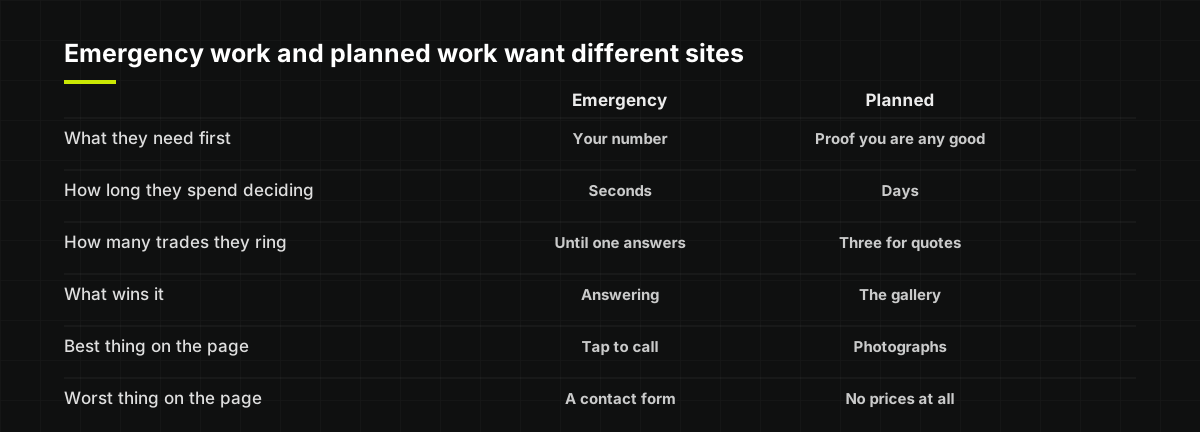
If you do emergency call outs, say so at the top, say what hours, and say roughly what it costs to come out. Trades resist that last one, and it is the thing that gets you the call. Somebody at two in the morning is choosing between three numbers and will ring the one that told them the truth about the call out charge.
And if you do not do emergencies, say that too. A page that is silent on it gets rung at two in the morning anyway, and you lose the sleep for nothing.
Reviews, and where they belong
Reviews on your own website are weaker than reviews on somebody else's, because you control your own site and everybody knows it. That does not make them worthless, it makes attribution essential.
- A name and a place beats a name. “Dave, Trowbridge” reads as real. “D.S.” reads as invented, even when it is not.
- Say what the job was. A review that mentions the actual work is worth three that say “great service”.
- Put one near the top. Not all of them on a separate page nobody visits.
- Never write them yourself. Beyond being dishonest, they read as fake, and one obviously invented review poisons every genuine one on the page.
The reviews that carry most weight are on your Google Business Profile and on platforms like Checkatrade, precisely because you cannot edit them. Link to those from your site rather than trying to replace them.
Your Google Business Profile matters more than your website
For local trades this is the uncomfortable truth, and any web designer who does not tell you is selling rather than advising.
When somebody searches for a plumber, the map results appear above the ordinary ones. Those come from Google Business Profiles, not websites. A complete profile with photographs and reviews will often produce more calls than the site itself.
It is free and takes about an hour. Do it before you do anything else, then let the website do the job the profile cannot: explaining the work, showing a proper gallery, and answering the questions that decide a larger job. The two work together, and we set out how in getting found on Google.
It has to be quick, on a phone, on bad signal
Your customers are not at a desk. They are in a kitchen, in a van, or standing in a garden with one bar of signal, and a site that takes eight seconds has already lost them.
The usual cause is photographs straight off a phone at four megabytes each. Twelve of those on one page is a gallery nobody will ever see. They need resizing before they go up, which is the single most common thing missing from a cheap trade site.
You can check your own site free at PageSpeed Insights. Put your address in and read the mobile score. If it is red, that is where your enquiries are going.
Choosing the address
Two rules, and the second matters more than people expect.
First, keep it short and sayable. You will read this out over the phone, on a van, and across a noisy building site. jsplumbing.co.uk survives that. j-s-plumbing-and-heating-services-bath.co.uk does not.
Second, and this is the one: register it in your own name, on an account you control, with your own email on it. Not your web designer's account, not your nephew's. A domain registered to somebody else is the one part of your business you cannot rebuild, and getting it back becomes a negotiation at the worst possible moment.
Whether to use .co.uk or .com barely matters for a local trade; .co.uk reads as local, which is mildly helpful. Putting your town in it is optional and slightly limiting if you ever expand. There is more on how domains and hosting fit together in what is a website.
What goes wrong most
In rough order of how often we see it, and how much it costs:
- No photographs of your own work. The single biggest one. Everything else is a detail next to it.
- A region instead of towns. Costs you the enquiries you never hear about.
- A phone number that is a picture. If it cannot be tapped, half your visitors will not ring.
- Nothing since 2019. A site with an out of date year in the footer reads as a business that has closed.
- Logos instead of numbers. Undersells the paperwork you actually hold.
- Huge images. Slow on the connection your customers are actually using.
- No prices of any kind. You do not need a price list. A range, or a call out fee, or “most bathrooms come in between” is enough to stop somebody bouncing.
- A form as the only way to make contact. Loses every urgent job.
Notice that none of these are design problems. They are all missing information, which is why a plain site with the right facts beats a smart one without them.
The checklist
Print this, or work down it on your own site now.
- Six or more photographs of your own finished work, shot in daylight, straightened, resized.
- Your registration number or numbers, written out, not just a badge.
- The amount your public liability insurance covers.
- Every town you cover, by name.
- Your phone number in the header of every page, tappable.
- A short form as a second option, three or four fields at most.
- Whether you do emergencies, what hours, and roughly what a call out costs.
- Three reviews with a first name and a town.
- A link to your Google Business Profile, and that profile filled in.
- A green mobile score on PageSpeed Insights.
- A year in the footer that is this one.
That is the whole thing. No trade website needs to be clever; it needs to answer eleven questions before somebody closes the tab.
If you would rather not build it yourself, that is what we do. We design and build the site around your trade at no charge, you see what we make before you pay anything, and the domain stays in your name, which we put in writing in our terms. Have a look at what we build for tradespeople, plumbers, electricians and builders, or read what a website normally costs first.