What the page is actually for
Almost nobody starts on the About page. People arrive on your homepage or a service page, from a search or a friend’s recommendation, and spend the first few seconds working out whether you do the job they need. Only once they think you might do they go looking for the page that tells them who you are.
That changes what the page is for. By the time somebody opens it they are already half persuaded, and often comparing you with one or two others. For a lot of visitors it is the last page they read before they ring, book or move on. It is a decision page, not a history page.
Underneath everything, the reader is asking two questions:
- Are you real? Is there an actual person behind this website, with a name and a face, who will still be there if something goes wrong?
- What will you be like to deal with? Will you turn up when you say, explain things properly, and treat their home, their hair or their money with care?
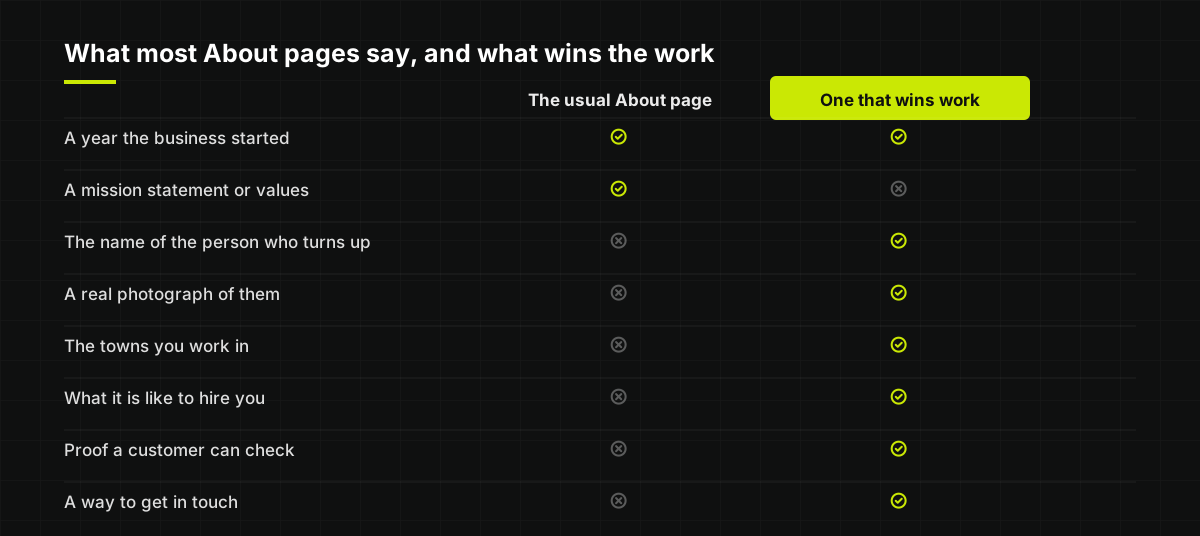
Everything on the page should help answer one of those. The year you were founded can help, if it is a long time ago. Your values statement almost never does, because every business has the same one and nobody can check it. Your name, your photograph and a specific description of how you work answer both questions at once.
There is a reason this matters more for a small business than a big one. A national chain is trusted because of its size. You cannot compete on that, and you do not need to. What you have instead is a person, and people hire people. The About page is where you get to show that, and most small business websites waste it.
The six things to include
A good About page for a small business needs six things. None of them takes long to write, and most owners already know every one of them.
- Who you are, by name. Your first name at the very least. A surprising number of small business websites never name a single person, which is a strange thing to do when you are asking strangers to trust you.
- A real photograph. Of you, recent, looking like you do when you turn up. This does more work than anything you write, and there is a section on it below.
- What you do, for whom, and where. One or two sentences. “I fit kitchens and bathrooms in older houses around Norwich” tells a reader more than three paragraphs about quality.
- How you work. The specific habits a customer will actually experience. Whether you quote in writing, how quickly you reply, whether you clear up every day, whether the person who quotes is the person who does the job.
- Proof a customer can check. Registrations with their numbers, qualifications people recognise, how long you have been doing this, and where your reviews live.
- A next step. The page is read by people who are nearly ready. End it with a way to contact you, not a dead end.
If you only change one thing
Put your name and your photograph on the page. It takes ten minutes and it answers the question every visitor is asking before they get in touch: who am I actually going to be dealing with?
A structure you can copy
You do not need to be a writer to get this right. You need the six things above, in an order that matches what the reader wants to know first. This shape works for nearly every small business. Each line is a short paragraph, two or three sentences at most.
- Hello, and what you do. “I’m [name], and I [do what] for [whom] in [where].” Start with the person and the job, not the date.
- How you got here. Where you trained, what you did before, and when you started on your own. One paragraph, not a biography.
- How you work. Two or three specific things a customer will notice. Not adjectives. Habits.
- Who else is involved. If anyone else will turn up, answer the phone or do the work, name them here. Skip this if it is just you.
- Proof. Registrations, qualifications and insurance that matter in your trade, with numbers. A line pointing to your reviews.
- The next step. “If you’d like a price, call me on [number] or send a photo of the job through the contact form.”
Done properly, that comes to somewhere between 250 and 500 words for most businesses. That is the right length. The page is read on a phone, by somebody deciding, and every extra paragraph is one more place for them to lose interest. If you find yourself going well past it, look for the parts that are about you rather than for them.
Use a heading or two if the page runs longer than a few paragraphs, and make the headings say something. “How I work” and “Who you’ll deal with” are useful because people scan headings before they read. “Our journey” and “Our ethos” are not, because nobody is looking for them.
I or we?
This is the question owners ask most, and the answer depends on one thing: how many of you there are.
If the business is you, write “I”. A lot of sole traders write “we” because they think it sounds bigger and more established. It does, briefly. Then the customer books, expects a team, and one person turns up. Nothing is wrong, exactly, but there is a small gap between what they were told and what they got, and that gap opens at exactly the moment you need them to trust you. Plenty of customers actively prefer a one-person business, because they know who will be in their house. Say so with confidence.
If there are several of you, write “we”, and name people. “We” on its own is faceless. “We’re a team of four: Dan quotes every job, and either Dan or Sam will be the one fitting it” is a team a customer can picture.
Avoid the third person. “Mark founded the company in 2011 with a vision to…” reads like a press release written about somebody else. It puts distance between you and the reader, which is the opposite of what the page is for. The one place it works is a team page, where short profiles of other people naturally use their names.
Your story, without the life story
Every guide to About pages says to tell your story. It is half right. A story earns its place on the page only when it explains something a customer will actually get. If it does not change what they experience, it is about you, and they will skim it.
Here is the test. Read your story back and ask: because of this, what do I do differently?
- “I’ve always had a passion for making people’s homes beautiful.” Because of this, nothing. Every decorator in the country could write that sentence.
- “I started on my own after years of watching jobs get rushed to fit in the next one. So I only take one job at a time, and I won’t start yours until I can finish it.” Because of this, the customer knows their job will not be left half done. That is a story worth telling.
Keep it to one paragraph. Leave out where you went to school, every job before this one, and anything that needs the phrase “from humble beginnings”. If your family has run the business for three generations, one sentence saying so is plenty. It is a nice fact, but on its own it does not tell anybody what you will be like to deal with.
And if you do not have a dramatic origin, do not invent one. Most people do not. “I trained at college, worked for a firm in town for eight years, and set up on my own in 2019 because I wanted to do the work my way” is a perfectly good story. It is true, it is specific, and it tells the reader you know the trade.
The same page, before and after
Here is the kind of About page that sits on thousands of small business websites. This one is for a hair salon, but swap a few words and it could be a café, a garage or a florist.
“Welcome to our salon! Established in 2015, we are a passionate team of stylists dedicated to making you look and feel your best. Our mission is to provide a luxurious, relaxing experience using only the finest products. We pride ourselves on exceptional customer service and attention to detail, and we look forward to welcoming you soon.”
Nothing in it is false, and nothing in it is useful. No names, no town, nothing a reader could check, and every sentence could sit on any salon website in the country. Now the same salon, written the way the owner would say it to a new client:
“I’m Hannah, and I opened this salon in the middle of Shrewsbury in 2015 after nine years cutting hair in Birmingham. There are two chairs: mine, and Leah’s. Leah has been with me since 2018 and does most of our colour work. We leave ten minutes either side of every appointment, so nobody is rushed and you’re never left waiting by the door. If you’re not sure what you want, book a short consultation first. Most of our regulars started that way.”
It is barely longer. Look at what changed:
- Two named people, and the reader knows which one to ask for colour.
- A town and a history that can be checked: nine years elsewhere, then their own salon since 2015.
- A working habit with a reason: the ten minute gap, and what the customer gets from it.
- An easy first step for the nervous new client, who is exactly the person reading this page.
The “passionate team” and the “finest products” have gone, and nobody misses them. That is usually how it goes. The general claims come out, the specific facts go in, and the page gets shorter and more persuasive at the same time. There is a longer worked example for a kitchen fitter in the guide to what to put on a small business website, along with four tests that catch most bad sentences.
Rather we wrote it with you?
We design and build small business websites with no build fee and no design fee. You tell us about the business, we turn it into the words and pages, and you see it before it goes live.
The photograph
If you put one thing on your About page, make it a photograph of yourself. People decide very quickly whether they feel comfortable with someone, and a face lets them do that before they have spoken to you. A page of words with no picture asks them to trust somebody they cannot see.
It does not need to be a professional headshot. It needs to be real, recent and you, looking the way you look when you arrive at somebody’s door or greet them in your shop. For many businesses the best photograph is not posed at all:
- A builder or a decorator on a job, in work clothes.
- A hairdresser at the chair, a café owner behind the counter.
- A yoga teacher in the studio, not on a beach.
- A plumber or an electrician next to a clean van with the name on the side.
Take it in daylight, ask someone else to hold the phone, and take twenty so that one of them is good. There are more practical tips on taking photographs on a phone in the guide to what goes on a small business website.
Two things to avoid. The first is stock photography of smiling people in suits, which readers recognise instantly and which tells them, without a word, that there is nobody real to show. The second is a photograph so old that the customer does not recognise you when you arrive. Replace it when you change, and give it a description for people using screen readers, such as “Hannah cutting a client’s hair in the salon”. That small habit is part of making a site accessible to everybody, and it costs nothing.
If you have a team
Once there are a few of you, the About page has a second job: showing a customer who they will actually deal with. That is not the same as listing everyone on the payroll.
- Name the people customers meet. The person who answers the phone, the person who quotes, the people who do the work. A firm of thirty does not need thirty profiles. It needs the five a customer will come across.
- Give each person one useful line. Their role and one thing that helps the customer: “Sam handles all our heating work and has been with us since 2017.” Not their favourite film.
- Use real job titles. “Office manager” tells a customer who to ask about an invoice. “Director of Happiness” tells them nothing.
- Ask before you publish. Some people are happy to be on a website and some are not. Ask each person, and respect a no.
- Keep it current. When somebody leaves, take them off the page that week. A customer who asks for someone by name, and is told they left a year ago, starts wondering what else on the website is out of date.
If the team section grows beyond a handful of people, give it its own page and keep a short summary with photographs on the main About page. The reader who wants everything can click through. The reader who just wants to know there are real people behind the business has their answer.
Proof, and what has to be there
The About page is the natural home for the details that prove you are who you say you are. The rule for all of them is the same: specific and checkable beats general and impressive.
Registrations and qualifications
If your trade has a register, show your registration number and link to the public register, so a customer can check it in two taps. For gas work that is the Gas Safe Register, and for electrical work it is usually NICEIC or NAPIT. A number and a link is worth more than a row of badges, because anybody can paste a logo onto a website. There is a full section on which registrations to show and how in the guide for tradespeople.
For other businesses, list qualifications customers recognise. A salon might mention a stylist’s training. A yoga studio might say where its teachers trained. Leave out anything a customer has never heard of and would not know how to value.
Insurance and experience
“Fully insured” is so common that readers no longer notice it. Saying what you actually carry, such as public liability insurance, is more convincing. For experience, give a starting year rather than a number of years. “Fitting kitchens since 2009” stays true forever. “Fifteen years’ experience” is wrong the following year, and quietly tells every reader that nobody has looked at the page since it was written.
The legal details for limited companies
If your business is a limited company, the law requires certain details on your website: the company’s registered name, its registered number, its registered office address, and where it is registered (England and Wales, Scotland or Northern Ireland). The GOV.UK guidance on what a company must show sets it out. Most sites put these in the footer so they appear on every page, and it does no harm to repeat them on the About page, where people looking for them tend to check first.
Reviews
Your About page does not need to carry all your reviews, but it should point to them. One short review with a first name and a town, plus a link to where the rest live, is enough. If the reviews are on your Google Business Profile, linking there is better than copying them, because a reader trusts them more where you cannot edit them.
What to leave out
Most bad About pages are not missing much. They are full of things that should not be there.
- “Welcome to our About page.” They know where they are. Start with your name.
- Mission statements and lists of values. “Integrity, quality, excellence” could belong to any business ever started. Show your values through specific habits instead.
- Claims nobody can check. “The best in the area”, “a leading provider”, “second to none”. Readers skip them, and some will distrust everything around them.
- A wall of logos. Trade body badges without numbers, manufacturer logos for products you once fitted, awards nobody has heard of. One checkable registration beats all of them.
- The full history. If your grandfather started the business in 1962, say so in one sentence. Three paragraphs of it is a page about your family, not about the customer.
- Text copied from your homepage. If the About page repeats the homepage word for word, the reader learns nothing new, and they came here to learn something.
- Anything out of date. Staff who have left, a number of years that stopped being true, a photograph from a decade ago. All of them suggest the business may not be paying attention.
The About page and search
It is worth being honest about this. An About page rarely ranks for the searches that bring in work, because people search for the job, not the biography. Nobody types “about a plumber in Leeds”. Your service pages do that work, and how to help them is covered in the guide to getting your business found on Google.
The About page still matters for search in two quieter ways. First, people who search for your business by name, often after a recommendation, frequently land on it, so it needs to confirm straight away that they have found the right business. Second, it is where your business name, the people behind it, your location and your contact details are set out clearly. Those details should match your Google Business Profile and every directory listing exactly, down to the way the address is written, because consistent details are part of what local search rewards.
A few practical things help both search engines and readers:
- Give the page a clear title. “About [business name], [what you do] in [town]” works far better as the title search engines show than plain “About us”.
- Use one main heading that says what the page is, and simple subheadings below it.
- Mention your town and the area you cover naturally, the way you would in conversation. Do not repeat it in every sentence. That reads badly to people and does nothing for you in search.
- Link from the About page to your services and contact page, so a reader who has been persuaded has somewhere to go.
- Keep it in the main menu, labelled “About”. Readers look for that word, and a clever label like “Our story” makes them hunt.
If your website is a single page, the same rules apply to an About section instead. Keep it to a photograph and two short paragraphs, and place it after your services and proof rather than first. The reasons for that order are explained in why the order beats the design.
The checklist
Before you publish, read the page on your phone and check it against this list.
- The first line says who you are and what you do, not “welcome”.
- At least one person is named, and it is clear who a customer will deal with.
- There is a real, recent photograph of that person, with a description.
- The town or area you cover is mentioned.
- There are two or three specific things about how you work.
- Any story explains something the customer gets.
- Registrations have numbers and link to the public register.
- Experience is given as a starting year, not a number of years.
- Limited companies show their registered name, number, office and where they are registered.
- There is a link to your reviews.
- The page ends with a phone number, a form or a button.
- It is written as “I” if it is just you.
- No mission statement, no unchecked claims, no stock photographs.
- It comes to roughly 250 to 500 words.
- Nothing on it is out of date.
The short version
The About page is read by people who are nearly ready to contact you, and they want to know who they will be dealing with. So tell them. Your name, a real photograph, what you do and where, how you work, and proof they can check. Write it the way you would say it to a customer, as “I” if it is just you. Keep the story to what changes the customer’s experience, leave out the mission statement, and end with a way to get in touch.
It is one of the shortest pages on your website and one of the easiest to get right. It just has to be about the person reading it, even though it is about you.